 Add to Chrome
 Add to Firefox
 Add to Edge
Subspace-Guided Semantic and Topological Invariant Registration for Annotation-Free Ultrasound Plane Quality Control
May 25, 2026
Reliable quality control (QC) of ultrasound images is essential for both real-time acquisition guidance and retrospective clinical audit, yet existing approaches rely heavily on per-plane annotations, or employ pseudo-labeling prone to systematic bias under spatial deformations inherent in clinical acquisition. We present STRIQ, a registration-driven framework that recasts annotation-free US plane quality control as a subspace-guided consistency measurement problem. Specifically, STRIQ introduces a Latent Registration Aligner (LRA) to establish hierarchical feature space correspondences between query images and variance-driven anchors, which are autonomously distilled from unlabeled data via a variance spectrum criterion to serve as structurally stable prototypes. To further disambiguate anatomical planes and mitigate negative knowledge transfer, we propose an Orthogonal Knowledge Subspace (OKS) module. The OKS decomposes plane-specific representations into mutually orthogonal subspaces, enabling fine-grained expert collaboration while preventing inter-plane interference, ensuring that the quality metric is grounded in principled subspace proximity. Extensive experiments on the in-house US4QA and public CAMUS datasets demonstrate that STRIQ achieves state-of-the-art correlation with clinical quality scores, establishing a new paradigm for annotation-free, real-time reliable ultrasound quality control. Our code is available at https://github.com/zhcz328/STRIQ.

Anatomy-Anchored Self-Supervision: Distilling Vision Foundation Models for Invariant Ultrasound Representation
May 25, 2026Self-supervised pre-training paradigm has gained increasing prominence for learning transferable representations in medical imaging, yet existing methods for ultrasound (US) images operate at the image or frame level, overlooking the anatomical context for clinical-aligned representation learning. In this work, we propose an anatomy-anchored ultrasound self-supervision framework ANAUS that shifts representation learning from generic visual regions to clinically meaningful anatomical structures. Utilizing a learnable latent prompt engine alongside a one-time domain adaptation on existing public image--mask pairs, we empower the LP-SAM module to achieve annotation-free anatomy delineation at scale. Building upon this anatomical grounding, we propose a dual-policy self-supervised learning paradigm consisting of inter-view semantics-aware anatomy-separating alignment and contextual core-region prediction to enhance representation learning. Specifically, the former enforces feature invariance within identical anatomical regions while promoting discriminability across distinct structures; the latter compels the model to reconstruct corrupted regions, thereby capturing fine-grained structural details. Extensive evaluations on six public datasets demonstrate that \ours{} consistently outstrips current state-of-the-art methods while maintaining the computational efficiency essential for clinical deployment. Code is available at https://github.com/zhcz328/ANAUS.
A-IO: Adaptive Inference Orchestration for Memory-Bound NPUs
Apr 10, 2026During the deployment of Large Language Models (LLMs), the autoregressive decoding phase on heterogeneous NPU platforms (e.g., Ascend 910B) faces severe memory-bound challenges. This study reveals the ``Model Scaling Paradox'' caused by the static deployment of single-sized models. It also points out the kernel synchronization overhead of fine-grained speculative decoding \cite{leviathan2023fast, chen2023speculative} under NPU computational graph compilation, and the severe limitations of purely relying on micro-level acceleration algorithms like Prompt LookUp Decoding (PLD)
Relaxed Triangle Inequality for Kullback-Leibler Divergence Between Multivariate Gaussian Distributions
Jan 31, 2026The Kullback-Leibler (KL) divergence is not a proper distance metric and does not satisfy the triangle inequality, posing theoretical challenges in certain practical applications. Existing work has demonstrated that KL divergence between multivariate Gaussian distributions follows a relaxed triangle inequality. Given any three multivariate Gaussian distributions $\mathcal{N}_1, \mathcal{N}_2$, and $\mathcal{N}_3$, if $KL(\mathcal{N}_1, \mathcal{N}_2)\leq ε_1$ and $KL(\mathcal{N}_2, \mathcal{N}_3)\leq ε_2$, then $KL(\mathcal{N}_1, \mathcal{N}_3)< 3ε_1+3ε_2+2\sqrt{ε_1ε_2}+o(ε_1)+o(ε_2)$. However, the supremum of $KL(\mathcal{N}_1, \mathcal{N}_3)$ is still unknown. In this paper, we investigate the relaxed triangle inequality for the KL divergence between multivariate Gaussian distributions and give the supremum of $KL(\mathcal{N}_1, \mathcal{N}_3)$ as well as the conditions when the supremum can be attained. When $ε_1$ and $ε_2$ are small, the supremum is $ε_1+ε_2+\sqrt{ε_1ε_2}+o(ε_1)+o(ε_2)$. Finally, we demonstrate several applications of our results in out-of-distribution detection with flow-based generative models and safe reinforcement learning.
LiNeXt: Revisiting LiDAR Completion with Efficient Non-Diffusion Architectures
Nov 13, 20253D LiDAR scene completion from point clouds is a fundamental component of perception systems in autonomous vehicles. Previous methods have predominantly employed diffusion models for high-fidelity reconstruction. However, their multi-step iterative sampling incurs significant computational overhead, limiting its real-time applicability. To address this, we propose LiNeXt-a lightweight, non-diffusion network optimized for rapid and accurate point cloud completion. Specifically, LiNeXt first applies the Noise-to-Coarse (N2C) Module to denoise the input noisy point cloud in a single pass, thereby obviating the multi-step iterative sampling of diffusion-based methods. The Refine Module then takes the coarse point cloud and its intermediate features from the N2C Module to perform more precise refinement, further enhancing structural completeness. Furthermore, we observe that LiDAR point clouds exhibit a distance-dependent spatial distribution, being densely sampled at proximal ranges and sparsely sampled at distal ranges. Accordingly, we propose the Distance-aware Selected Repeat strategy to generate a more uniformly distributed noisy point cloud. On the SemanticKITTI dataset, LiNeXt achieves a 199.8x speedup in inference, reduces Chamfer Distance by 50.7%, and uses only 6.1% of the parameters compared with LiDiff. These results demonstrate the superior efficiency and effectiveness of LiNeXt for real-time scene completion.
Enhancing Small-Scale Dataset Expansion with Triplet-Connection-based Sample Re-Weighting
Aug 11, 2025The performance of computer vision models in certain real-world applications, such as medical diagnosis, is often limited by the scarcity of available images. Expanding datasets using pre-trained generative models is an effective solution. However, due to the uncontrollable generation process and the ambiguity of natural language, noisy images may be generated. Re-weighting is an effective way to address this issue by assigning low weights to such noisy images. We first theoretically analyze three types of supervision for the generated images. Based on the theoretical analysis, we develop TriReWeight, a triplet-connection-based sample re-weighting method to enhance generative data augmentation. Theoretically, TriReWeight can be integrated with any generative data augmentation methods and never downgrade their performance. Moreover, its generalization approaches the optimal in the order $O(\sqrt{d\ln (n)/n})$. Our experiments validate the correctness of the theoretical analysis and demonstrate that our method outperforms the existing SOTA methods by $7.9\%$ on average over six natural image datasets and by $3.4\%$ on average over three medical datasets. We also experimentally validate that our method can enhance the performance of different generative data augmentation methods.
Interactive Hybrid Rice Breeding with Parametric Dual Projection
Jul 16, 2025

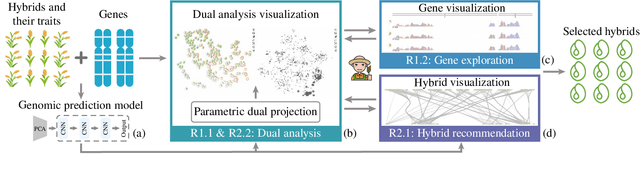
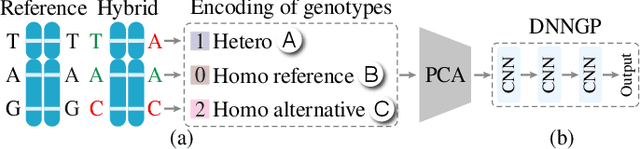
Hybrid rice breeding crossbreeds different rice lines and cultivates the resulting hybrids in fields to select those with desirable agronomic traits, such as higher yields. Recently, genomic selection has emerged as an efficient way for hybrid rice breeding. It predicts the traits of hybrids based on their genes, which helps exclude many undesired hybrids, largely reducing the workload of field cultivation. However, due to the limited accuracy of genomic prediction models, breeders still need to combine their experience with the models to identify regulatory genes that control traits and select hybrids, which remains a time-consuming process. To ease this process, in this paper, we proposed a visual analysis method to facilitate interactive hybrid rice breeding. Regulatory gene identification and hybrid selection naturally ensemble a dual-analysis task. Therefore, we developed a parametric dual projection method with theoretical guarantees to facilitate interactive dual analysis. Based on this dual projection method, we further developed a gene visualization and a hybrid visualization to verify the identified regulatory genes and hybrids. The effectiveness of our method is demonstrated through the quantitative evaluation of the parametric dual projection method, identified regulatory genes and desired hybrids in the case study, and positive feedback from breeders.
Let Synthetic Data Shine: Domain Reassembly and Soft-Fusion for Single Domain Generalization
Mar 17, 2025Single Domain Generalization (SDG) aims to train models with consistent performance across diverse scenarios using data from a single source. While using latent diffusion models (LDMs) show promise in augmenting limited source data, we demonstrate that directly using synthetic data can be detrimental due to significant feature distribution discrepancies between synthetic and real target domains, leading to performance degradation. To address this issue, we propose Discriminative Domain Reassembly and Soft-Fusion (DRSF), a training framework leveraging synthetic data to improve model generalization. We employ LDMs to produce diverse pseudo-target domain samples and introduce two key modules to handle distribution bias. First, Discriminative Feature Decoupling and Reassembly (DFDR) module uses entropy-guided attention to recalibrate channel-level features, suppressing synthetic noise while preserving semantic consistency. Second, Multi-pseudo-domain Soft Fusion (MDSF) module uses adversarial training with latent-space feature interpolation, creating continuous feature transitions between domains. Extensive SDG experiments on object detection and semantic segmentation tasks demonstrate that DRSF achieves substantial performance gains with only marginal computational overhead. Notably, DRSF's plug-and-play architecture enables seamless integration with unsupervised domain adaptation paradigms, underscoring its broad applicability in addressing diverse and real-world domain challenges.
VLScene: Vision-Language Guidance Distillation for Camera-Based 3D Semantic Scene Completion
Mar 08, 2025Camera-based 3D semantic scene completion (SSC) provides dense geometric and semantic perception for autonomous driving. However, images provide limited information making the model susceptible to geometric ambiguity caused by occlusion and perspective distortion. Existing methods often lack explicit semantic modeling between objects, limiting their perception of 3D semantic context. To address these challenges, we propose a novel method VLScene: Vision-Language Guidance Distillation for Camera-based 3D Semantic Scene Completion. The key insight is to use the vision-language model to introduce high-level semantic priors to provide the object spatial context required for 3D scene understanding. Specifically, we design a vision-language guidance distillation process to enhance image features, which can effectively capture semantic knowledge from the surrounding environment and improve spatial context reasoning. In addition, we introduce a geometric-semantic sparse awareness mechanism to propagate geometric structures in the neighborhood and enhance semantic information through contextual sparse interactions. Experimental results demonstrate that VLScene achieves rank-1st performance on challenging benchmarks--SemanticKITTI and SSCBench-KITTI-360, yielding remarkably mIoU scores of 17.52 and 19.10, respectively.
Vision-based 3D Semantic Scene Completion via Capture Dynamic Representations
Mar 08, 2025The vision-based semantic scene completion task aims to predict dense geometric and semantic 3D scene representations from 2D images. However, the presence of dynamic objects in the scene seriously affects the accuracy of the model inferring 3D structures from 2D images. Existing methods simply stack multiple frames of image input to increase dense scene semantic information, but ignore the fact that dynamic objects and non-texture areas violate multi-view consistency and matching reliability. To address these issues, we propose a novel method, CDScene: Vision-based Robust Semantic Scene Completion via Capturing Dynamic Representations. First, we leverage a multimodal large-scale model to extract 2D explicit semantics and align them into 3D space. Second, we exploit the characteristics of monocular and stereo depth to decouple scene information into dynamic and static features. The dynamic features contain structural relationships around dynamic objects, and the static features contain dense contextual spatial information. Finally, we design a dynamic-static adaptive fusion module to effectively extract and aggregate complementary features, achieving robust and accurate semantic scene completion in autonomous driving scenarios. Extensive experimental results on the SemanticKITTI, SSCBench-KITTI360, and SemanticKITTI-C datasets demonstrate the superiority and robustness of CDScene over existing state-of-the-art methods.